
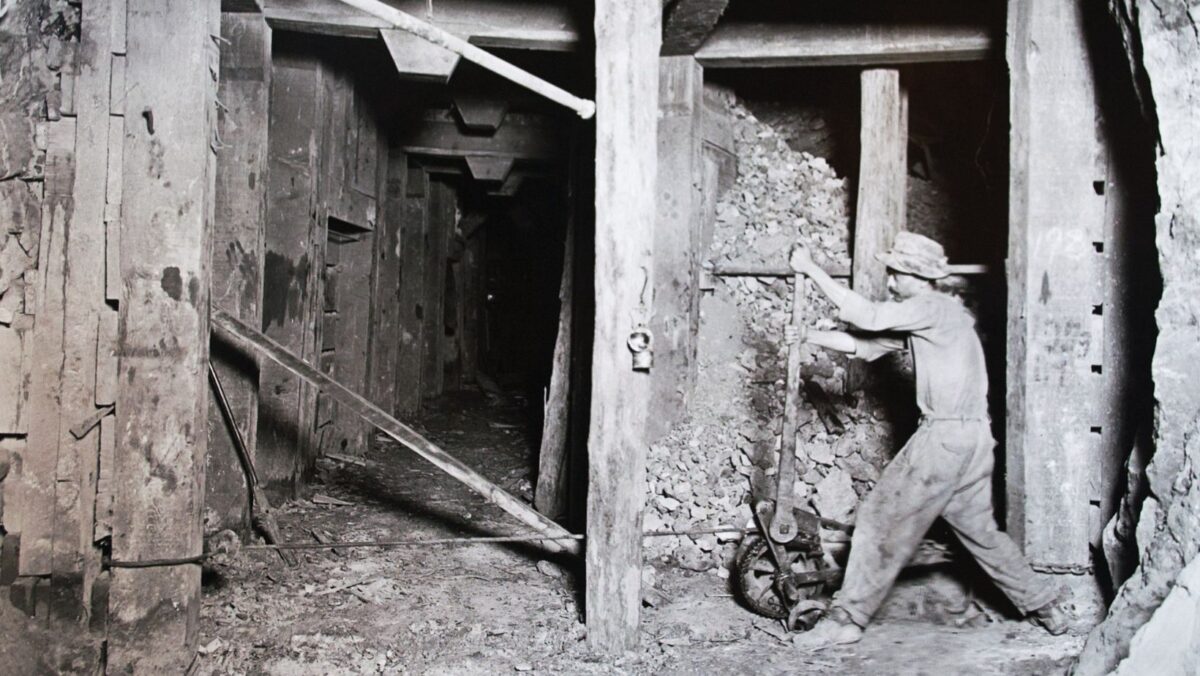
Inside the Pilares Mine: Copper Mining, Stoping, and Milling at Nacozari, Mexico (1911)
12 de octubre de 2026
(Unknown Author)
“Most of the underground workers, and many of those on the surface, including machinists and the workmen in the concentrators, are Mexicans.”
(1911) – The Pilares mine of the Moctezuma Copper Company is six miles southeast of Nacozari, Sonora, Mex., and about 85 miles south of Douglas, Ariz. The mine takes its name from the great green pillar-like rocks at the top of the mountain. Ore was found at a depth of 60 ft., and the oxidized zone was found to be barely 20 ft. in thickness.
The Pilares mine lies in a rugged, hilly country, and is reached from Nacozari by a narrow-gage railroad, over which the ore from the mine is hauled to the new concentrator at Nacozari. The ground has been proved by diamond-drill boring. The ore occurs in a broad friction zone of broken porphyry. The ore is auriferous chalcopyrite, though bornite occurs with pyrite. There seems to be no clearly defined foot-wall, and until recently the orebody was believed to be about 800 ft. wide and 1500 ft. long at the top, increasing with depth. The ore mined assays about 3.22 per cent copper. In plan the orebody is semi-circular. Early work was confined to the southeast side, as it was for a long time supposed that the orebody was limited on the south by a dike of caliche, but development work has proven that the ore extends far to the east beyond that supposed boundary line, on all levels from the second to the ninth. The Y-shaft, sunk from the Porvenir tunnel level (from the seventh to the tenth) shows both the eighth and ninth levels rich in ore that has been cut on both sides of the caliche in drifting toward the Santa Cruz stopes.
The Pilares mine is practically without water; the long tunnels driven under the workings and the shafts perfectly ventilate the mine. From one of the stopes the company extracted 150,000 tons of ore. The uniformity and shape of the orebody in the Pilares mine permit systematic development.
Method of Stoping
The ore was extracted in stopes 100 ft. square. After removing the ore, the depleted stopes were formerly caved in from the surface, left empty, or filled, according to the hardness of the rock. For filling, rock was quarried from a hill immediately adjacent to one of the main vertical shafts. When one stope had been drawn and filled, another 100-ft. square was stoped, and the process repeated the entire length of the orebody. Another section was then started, with 100 ft. between it and the first, and the same plan followed. The section between could then be stoped while the ground was held by the broken rock on either side. Now the ore is mined in approximately this size section, but the stope is filled with waste and the men work on top of it as they break down the next slice across the roof. The 25-ton cars, drawn by electric locomotives, run into the mine through an adit a mile long. The ore chutes are cut through rock and the ore is drawn directly into railroad cars.
The principal copper mineral is chalcopyrite which occurs in coarse seams through a much brecciated porphyry, enabling the 2000-ton concentrator to make a recovery of 84 to 86 per cent of the copper in the ore.
The Mills
There are two mills, but the old one is no longer in use. The old concentrator designed by L. D. Ricketts had a capacity of 600 tons daily and was operated by electric power; it was equipped with two Blake crushers, four sets of 54×30-in. roughing rolls, two sets of finishing rolls, 24 revolving screens, 10 five-foot Huntington mills, 48 Hartz jigs, 56 six-foot Frue vanners, 20 Bartlett tables, seven settling tanks and hydraulic classifiers.
In this old mill the experiments were made to determine the equipment for the new plant designed by H. K. Burch and completed in June, 1908. The new mill has a capacity of 2,000 tons daily. The equipment includes 15 Allis-Chalmers three-phase, 60-cycle, 220-volt induction motors, of 10 to 75 h.p. each, and 70 Risdon-Johnson concentrating tables. This mill makes concentrate of about 12 per cent copper, saving about 86 per cent of the metal in the ore.
The mill is built of steel and concrete throughout. The gallery floors are made of reinforced concrete as are also the elevator housings and settling tanks. The launders are placed in tunnels beneath the floor of the concentrating tables, as was done at the Boston Consolidated mill, at Garfield, Utah. Dust collectors are used wherever dry crushing is done with such good effect that the atmosphere of the mill is practically free from dust.
All ore is weighed by Blake-Denison machines, and before going through the rolls passes on a conveyer belt below large electromagnets to remove such pieces of iron as may have become mixed with the ore. The old smeltery is not used now. All the concentrate is shipped over the Nacozari railroad to the Copper Queen smeltery.
During 1910 the mill treated 447,555 tons of ore of an average tenor of 2.99 per cent copper, from which 107,014 tons of concentrate containing 11,301 tons or 10.56 per cent copper was produced. The yield of copper was 2.5 per cent of the ore, the ratio of concentration 4.182:1, and the tailing assayed 0.60 per cent copper.
The production of ore for 1910 was 434,773 tons delivered to the railroad bins, of which 74.3 per cent came from cut-and-fill stopes; 8.7 per cent. from development work; 13.9 per cent from swell of shrinkage stopes and the remainder from the reserves of previous years. An addition of 120,982 tons was made to the reserves, making the total ore broken during the year 555,755 tons.
Most of the underground workers, and many of those on the surface, including machinists and the workmen in the concentrators, are Mexicans. The company has erected a fine casino, including a little theater, where moving pictures and dramas are presented for the benefit of the employees. There is also an excellent company library, well stocked with works in Spanish and English, pool and reading rooms, and bowling alley.
Power Plant
The power plant was completed in 1908; it has a battery of Sterling boilers with reinforced-concrete stacks 196 ft. high. Steam turbines and electric generators supply power for the camp, the concentrator and the mine. The total power for the year 1909 was 8,584,090 kilowatt-hours, the average having increased 50 per cent over the previous year, but the coal consumption was 3.05 lb. per kilowatt-hour less. A Roney stoker installed at one of the boilers showed an increased evaporation of 1.2 lb. of water over hand firing.
The other boilers are to be equipped with these stokers, and machinery installed to convey coal from the storage bin. Both gas and steam power are used at the old power plant, principally the former. Loomis-Pettibone generators make both producer and water gas, which are stored in separate gasometers of 15,000 and 5,000 cu.ft. capacity, respectively. The gases are mixed before using. The old power plant has eight 100-h.p. Crossly, single-cylinder, four-cycle gas engines, and one of 200 h.p. These engines are connected with 65-kw. and 150-kw. generators. The current is sent to more than 40 motors at 250 volts. The electric power to the mine is transmitted six miles at 6,600 volts, and stepped down at the mine to 230 volts for the pump. The hoists and electric locomotives use the 250-volt current direct.
Photos: Pilares de Nacozari mine tunnel – Phelps Dodge Collection – Freeport-McMoRan, Inc.
Published on Engineering and Mining Journal
New York, New York, May 20, 1911
Original Title: The Pilares Mine at Nacozari
© All Rights Reserved