
Nacozari Oasis in Barren Hills; Mines to Double Daily Capacity
8 de julio de 2026
By George W. Lynn
Beautiful weekend trip through canyons and mountain hills
(1920) – Nacozari, contrasting itself against the barren hills of Sonora and lower Arizona, is a restful stop in which to spend a weekend. The trip from Douglas to the little mining town is a beautiful one, most of the way. The pathway of the rails winds through deep, wooded canyons and along brooks which have not yet gone dry.
Nacozari is surrounded by high hills. The soil upon which the town sets the fertile and the yards of most of the residences are filled with profusion of flowers and foliage.
Enlarge Facilities
Just a this time Nacozari is booming. Practically one million dollars is being spent to enlarge the electric plant situated there, so that adequate power can be obtained to double the capacity of the Moctezuma Copper Company mines at Pilares. The capacity of the concentrator at the present time averages 2,000 tons and with additional power, a capacity of 4,000 tons per day is contemplated. Seven new diesel engines are being installed at the Nacozari electric plant. H. T. Hamilton is general manager at Nacozari, and Frank Ayer is in charge of operations at the mines in Pilares, which is about six miles from Nacozari. E. Leeland is assistant superintended at the mines.
A. C. Strauss, secretary to J. S. Williams Jr., president of the Ferrocarril de Nacozari railroad, who was in Nacozari with his wife to spend the weekend, told the writer that doubling the capacity at the mines would probably cause train service also to be doubled. At least, he said, an additional daily freight train between Nacozari and Douglas would be needed.
Good Road Bed
The road bed of the railroad is kept in perfect condition. The road itself is a freak of engineering. The percentage of grade at various points in the mountains is enormous and only through much twisting and winding has it been possible to lay the track.
Nacozari has a good hotel, owned by the mining company and managed by W. N. Flippin. Mr. Flippin is having the building repaired and is making several improvements. The hotel contains 90 rooms, most of them with outside exposure. Regular family meals are served at the hotel and practically all the Americans employed in Nacozari live there.
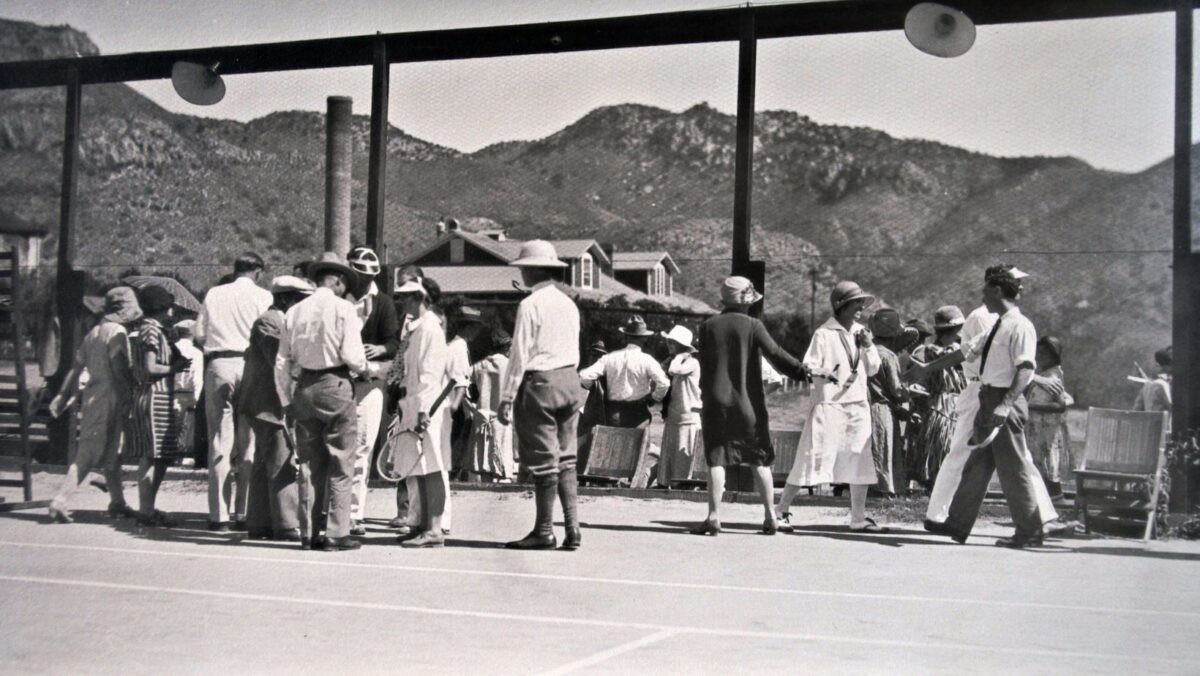
Sunday the town entered its interest on a big tennis tournament, which was played between Pilares and Nacozari on the newly completed courts in the latter place. P. G. Beckett, general manager of the Phelps Dodge corporation put up a beautiful cup for the winner of championship. At the end of the tournament the honors were equal and it was necessary to select new teams to play off the tie, which resulted in Pilares winning the cup.
All-Night Serenades
Sunday evenings, the Nacozari band gives a concert in the public square, and it seems it is the custom of the players, after the concert is finished, to serenade one another’s friends and sweethearts. As the whole town does not cover much space, the populace has music all night. It is great until some hombre gets too much mescal and tries to sing tenor with a bass voice.
As far as outside appearances go, Nacozari is as dry as a W.C.T.U. convention. No saloons, no gambling dens or mine joints.
The Nacozarians have a beautiful library and recreation building which is furnished by the mining company. It has reading rooms, pool halls, gym, and a picture show. The auditorium where pictures are shown is used also for dancing. In the second story of the building the American school is located. The building is made of stone and is beautiful and modern in architecture. The company’s offices are also located in Nacozari. This building is also built of stone and its office fixtures are of an up-to-date type.
Great Home Lovers
The Mexicans who live in Nacozari are great home lovers. They fill their tiny yards with flowers and foliage and keep everything immaculately clean. They are also admirers of mocking birds and from nearly every door hands a cage with its gay songster.
Magnolias, poppies, oleanders, and varied types of roses are in the yards. Peaches, apricots and palm trees are also in abundance.
A few miles from Nacozari—just a nice morning walk—is Pilares, where the mines are located. The folks up there have a sort of town of their own, although Nacozari, by far, is the most beautiful and ideal place.
The employees seem satisfied. They are comfortably quartered and through their various teams, find plenty of amusement. Many of them expressed a desire for more to read, however. All are eager for the Douglas-to-Nacozari excursion to be carried out. It will be a day of sight-seeing and pleasure, as well as giving Nacozari’s American neighbors an opportunity to see what they are doing. It was learned in Nacozari Monday that the citizens intended to map out a program of entertained which would keep the Douglas visitors interested when they came down next Sunday.
School in Session
Public schools in Sonora have not closed. In the villages on the way to Nacozari the kiddies can be seen in study, and at play at recess times. They march to and from their rooms much in the same order as do American children, and show a high degree of discipline. The teachers lead the children in games at recess times.
Through the various valleys which the railroad winds on its way to Nacozari are many farms, the majority being filled with truck, although a great deal of wheat was observed. In some places wheat is being threshed. Two farms were using modern machinery, while some others, after cutting the wheat, were threshing in a primitive way.
Ancient Methods
Three men, with forks and spades turn the wheat and pound the grain. Apparently it is a very inefficient way and no doubt 30 to 40 percent of the grain is lost.
The truck farms are doing well. In many localities potatoes are being made ready for shipment; cabbage is ready for market, as are onions, radishes, and similar truck.
There is little water in the streams, but farmers are diligently conserving what is left. On two of the three little truck farms, just below Douglas, in Sonora, Mexicans are using the sewage waste water from this city to irrigate their land.
The trip to Nacozari is an ideal weekend one. A mixed train leaves Agua Prieta Saturday afternoon at 1:35 o’clock and reaches Nacozari about 6 o’clock—just in time to get to the hotel, clean up and get down to supper, which flying Chinese men serve. The meals contain a variety of vegetables grown in and around Nacozari, and are served at minimum cost. Sunday gives the pleasure seeker sufficient time to climb the hills, see the mines, the dam, the “castle on the hill,” a beautiful old home set far away in a canyon, and it will be a dull day if there isn’t some kind of a hotly contested game on between the miners. At 7 o’clock Monday morning, the train leaves Nacozari for Agua Prieta, reaching the latter point about 11:30 o’clock.
Published on Douglas Daily International
Douglas, Arizona, June 1, 1920
19th Year – No. 299
© All Rights Reserved