
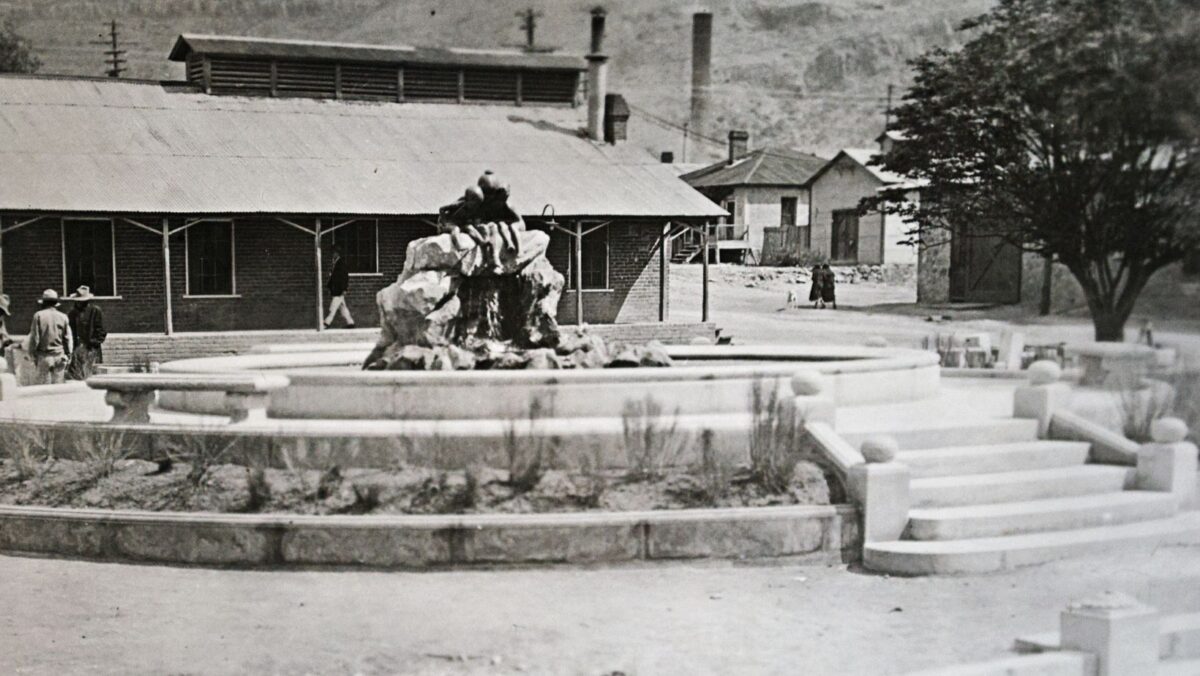
Plaza at Nacozari is Setting for Rare Art Pieces
8 de julio de 2026
(Unknown Author)
Memorial provided by children of late Dr. Douglas for their distinguished father, founder of town
(1931) – When those who planned the town of Nacozari, the “model mining camp of Mexico,” laid out the townsite, they provided what was to become a sort of formal welcome to visitors to the place. They developed a plaza in which there is an attractive fountain with rare art, grass plots, a memorial monument and the band-stand, where musical programs may be offered on occasions. Necessarily, they didn’t, when they laid out the town, know there was to be a need for a monument for a local citizen so soon, but the occasion came and there stands in the plaza a fine monument, a tribute to the heroic deed of one of the workmen who lessened the loss of life when a serious explosion happened a few years ago and who lost his life in the effort he made.
Nacozari, as the accompanying picture shows, sets in a bowl of the mountains. The railway enters through a canyon of rare beauty. The railroad comes in well toward the center of the little valley that spreads out to provide a site for the town and the plaza is on the north side of the track.
As one leaves the station for the Nacozari hotel, he comes to the memorial fountain erected by the sons and daughters of Dr. James Douglas, the president of the Phelps Dodge corporation, and who founded the town in 1897. This fountain is a striking bit of art, being in bronze by a French sculptor, and portrays a mother and her children at the bath. They are watching three frogs sitting on the opposite bank and apparently hesitate to enter the water because of the amphibians. It is an exceptionally finely wrought piece of art and an enduring one.
In the rectangles which stand at either side of the fountain, there are two urns chiseled from native stone, also pieces of fine art and constituting, with the fountain, the memorial to Dr. Douglas. These provide a center in which the people of the town hold a fine pride, not only because of the artistic worth of the statuary, but because it pays tribute to the memory of the man who founded the town and whose name is revered by the people generally.
The monument stands further west and it was erected by the people through popular subscription in recognition of his heroic act in pulling a couple of cars loaded with high explosives out of the yards before they exploded after fire had been discovered in them, but too late to extinguish. Jesús García was the name of the engineer of the mine railroad, whose name will endure through time because of his act, and the monument which attests it.
In this same plaza is an elegant band-stand, which not only offers utility value, but was constructed to make it an integral part of the plaza, where the other pieces carry high values because of their art.
The picture shown here gives a photographic view of the little town and it will be observed that the plaza is clearly defined. The large building to the south of the plaza is the general offices of the Moctezuma Copper Company, the operating unit of the Phelps Dodge company, and directly across the plaza from it stands the Nacozari hotel, a hostelry modern and complete, where the visitor always finds a welcome and any information that may make his visit pleasant.
Being a mining camp may have explained the fact that early in its history Nacozari secured a hospital ample for a city much larger than its numbers disclose. The hospital is a one-story structure set back in a part of the town where quiet always is assured, and surrounded by trees that make the scene a pleasing one. It can accommodate 20 patients. Flowers as well as trees add to the beauty of the scene and make the place so attractive that one might well wish if he had to be sick and have hospital treatment, he could have it here in this hospital.
The setting and the surroundings of Nacozari make it easily one of the most attractive little towns in this area. It is connected with Douglas by the Nacozari railroad and is reached by a trip of three hours travel.
Published on Douglas Daily Dispatch
Douglas, Arizona, May 10, 1931
Vol. XXVIII, No. 270
© All Rights Reserved