
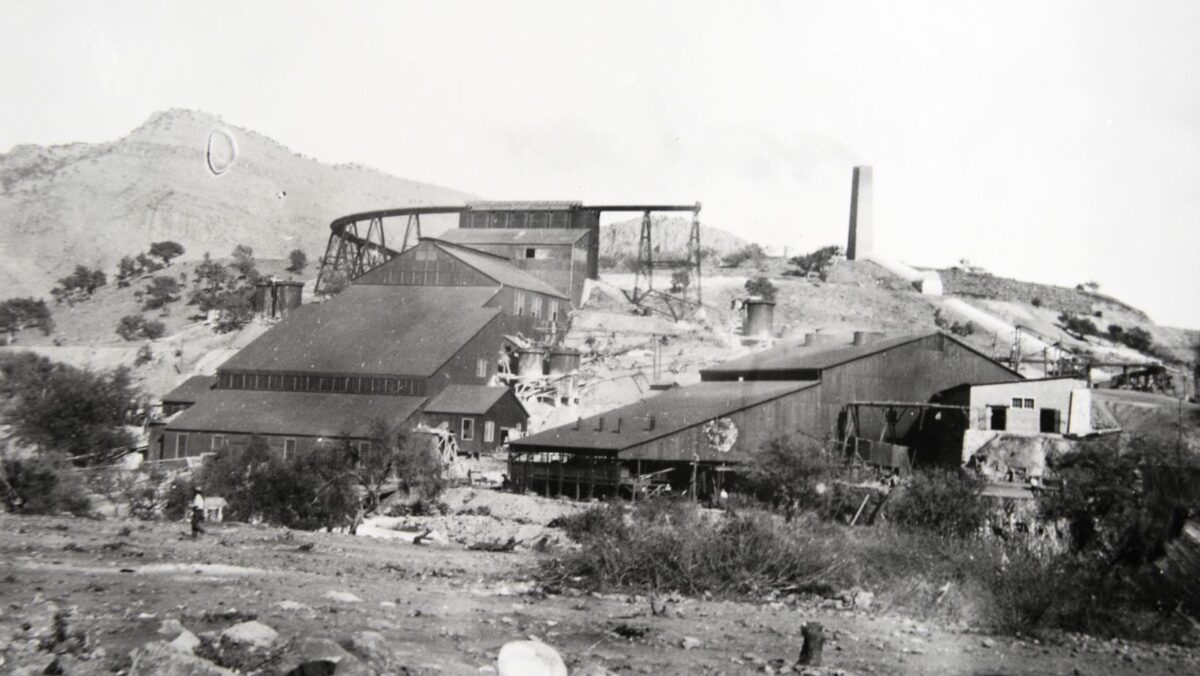
Work Accomplished by the Moctezuma Copper Company at Nacozari, Sonora (1900)
10 de septiembre de 2025
By H. B. Layton
A mountain of copper ore to be turned into gold by modern facilities—The Pilares mine, owned by Phelps, Dodge & Co. is reckoned as the greatest in America.
(1900) – The colossal copper mining and milling enterprise of Phelps, Dodge & Co. of New York at the near Placeritos de Nacozari, Sonora, Mexico, ninety-eight miles south of Bisbee, Arizona, is nearly ready for operation. At a preliminary expense of approximately $3,000,000 gold, the owners at Bisbee, Globe and Morenci have opened up a new mineral country that will yield products of enormous value. The work accomplished by the Moctezuma Copper Co., the corporate title of the Sonora enterprise, would, on paper, appear impossible; but it is practically complete, it is a reality. Within a few weeks after this article is given to the public, the two 5-ton vessels in the converting mill will be pouring copper 98 per cent fine.
At the outset the natural question is: ‘What is the character and extent of the ore bodies that are deemed of sufficient value to justify a preliminary expense of more than $3,000,000 gold before a pound of product has yield a cent of return?’ The answer is brief: ‘A mountain of medium and low/grade sulphide ore.’ But a more specific explanation will interest the technical world, whose eyes are watching the progress of this giant undertaking and its general bearing upon the industry of mining, concentrating, smelting, and converting.
The beginning of the history of the Moctezuma Copper Company was capital and the nerve to spend it.
The Guggenheims of New York might have arrived at the same results when they owned and operated the property. They had a 100-ton plant at old Nacozari that was fast becoming obsolete. The faithful but inefficient burro was the carrier between the five miles that separated mine and mill: fuel was far away and, therefore, costly. When they realized that only modern facilities could turn that mountain of ore into gold that would outweigh the cost of getting it, they balked. Then they made overtures to the Phelps-Dodge people. Prof. James Douglas, who represents them as president of the companies at Bisbee, Globe and Morenci, and Professor L. D. Ricketts, whose success in mineralogy and metallurgy has brought him fame, examined the Pilares mine, a patented property with a surface area of 150 pertenencias. Their report was favorable, with the qualification that only by an enormous investment could the proposition be made to pay. This was easy to people whose joint income is not much—if any—below $10,000,000 per annum.
Therefore, the Moctezuma Copper Company was organized; the deal with the Guggenheims was closed on the lines, it is understood of $1,000,000 for the property. A ranch of 12,000 acres, on which was perpetual water, a fine mill and townsite, was bought for $30,000; $1,000,000 was appropriated for the reduction plant, mine development, six miles of railroad between mine and mill and town. Another million was appropriated for a 96-mile extension of the Arizona & Southeastern railroad from Naco to Placeritos de Nacozari, the new town where the mill is located. This amount will not complete and equip the road, but it is a good starter. Two years ago, work was commenced. John Evans is superintendent of the mine. Daniel Huff surveyor and accountant.
The Pilares mine was so named because of the presence of pillar-like rocks that project above the mountain and may be seen from adjacent hills many miles away.
Its first level elevation is 2,250 feet above sea level and 1,250 feet above the mill. Development has progressed to the sixth level. Down to this point, the ore body has been so well explored that it is known that nearly quite 2,500,000 tons of available ore are in sight. The 3-compartment mail shaft is down to the third level and the work of sinking to the sixth is in progress. The shaft is fitted with two steel safety cages, operated on the alternating system by a 25-h. p. gasoline engine. The sixth level is a 7 x 9-foot double-track tunnel, leading from Rosario canyon at grade of railroad terminus at this point. It will tap the main shaft 5,000 feet from the portal, and will require nearly another year to complete. Nearly 2,900 feet have been made through the porphyry, and the ore body is but little farther in.
A sawmill has been installed on Porcupine Mountain, thirty-five miles from the mine and connected with it by a narrow-gauge railroad. At the mine terminus at Porvenir, in Rosario canyon, is the base of the inclined plane that climbs to Pilares mountain. It is 1,900 feet long on a 33 per cent grade with two trestles over gulches. The tracks are 3-foot gauge, with three rails from the foot to the turnouts and four rails from that point to the top. Being of gravity type, the loaded car carried by the skip in descending carries the empty car and skip to the top. Electricity is the motive power of the entire plant; W. A. Ferguson is electrician. The powerhouse, 108 x 62 feet, is structural steel sheathed with corrugated iron. A 12-ton traveling crane, with a 25-foot span, is available the entire length of the building. Eight gas engines each 40,000 pounds eight complete, rated a 110 I. H. P., with a speed of 200 revolutions per minute, operate eight dynamos. Each engine has two hot tube lamps and outboard bearing that helps support the 10-ton fly wheel. They are the regular four-cycle hit and miss type. The gas system is a water gas process, a combination of water gas and hydrocarbon, made in a special apparatus similar to that now in practical operation at the Morenci works. In addition, 400 c. p. incandescent and are lamps, constant potential, will be distributed through the mills and the town. A 15-h. p. dynamo, run by a 16-h. p. gasoline engine, is installed at the mine and runs a 10-h. p. motor ventilator and six 15-inch Sturtevant blowers. Ultimately rotary and statistic transformers may be installed in the powerhouse and transmitted to the mine to operate tramway motors, for lighting and other purposes.
The concentrate plan of 400 tons daily capacity, erected and to be operated under the supervision of J. T. Hall, is practically complete. The entire building, 90 x 200 feet, in which 60,000 feet of masonry was used, is still-framed and sheathed with corrugated iron. The motive power of the mill is electricity, brought from the central power station and accelerated through motors. The smelter building is steel structure, 175 x 62 feet, equipped with two 450-ton blast furnaces, two 5-ton Bessemer converters, hydraulic pump and accumulators, a tilting matte settler, crushers and pans for grinding quartz used in lining converters, furnaces for drying furnace lining, turntables, hydraulic elevators and other equipment. South of the smelter is the coke bin, 70 x 30 x 20 feet. Near the smelter also are the gas plant and cold storage bins. Farther south are the machine and blacksmith shops, equipped with lathes, drilling presses, shapers, bold and pipe cutters, and other machinery for repair work.
North of the mill, across the little stream, is the town. Nearest the stream are fifty brick tenements in two long blocks. Across the plaza, 500 feet long by 140 wide, is the hotel, 260 feet long, and the store building, 264 feet long. Farther north are blocks of houses occupied by Dr. Giles H. Hall, company physician, J. W. Moodie and other heads of departments. Beyond these, at a higher elevation, is the structure reserved for offices of the company. A brick schoolhouse stands at the west end of the plaza. Upward of 100 skilled Americans are employed, and 350 Mexicans. The latter receive from $1.50 to $2 per day, according to the work performed. The pay of skilled men is the same as in other camps of the company in the States. When the mine and reduction departments are in complete running order, employment will be given to 400 to 500 men in the former and perhaps 350 to 400 in the milling plant.
The policy of the company to do custom smelter work, together with the advent of the railroad, will prove an immense stimulant to mining in that section. Numerous copper locations and gold and silver properties now assume importance that, without smelter and transportation facilities, were of little value to their owners. From Naco, a new town on the international boundary, nine miles southwest of Bisbee, work on the extension of the Arizona & Southeastern is in progress. Forty-pound rails and ties sufficient for forty-five miles of railroad are stored there, and Steeler & Lusk, Chicago contractors, expect to complete this mileage by August.
Published on the Arizona Silver Belt
Globe, Arizona, April 5, 1900
Originally published on the
Mining and Scientific Press of San Francisco, CA
About the author:
H. B. Layton was an American mining correspondent and technical writer active around the turn of the twentieth century. He contributed articles on mining operations in the U.S. Southwest and northern Mexico to leading industry publications. Little is known about his personal life, but his work was widely reprinted in regional mining newspapers.
© All Rights Reserved