
The Nacozari Mines, Mexico (1900)
5 de febrero de 2026
By H. B. Layton
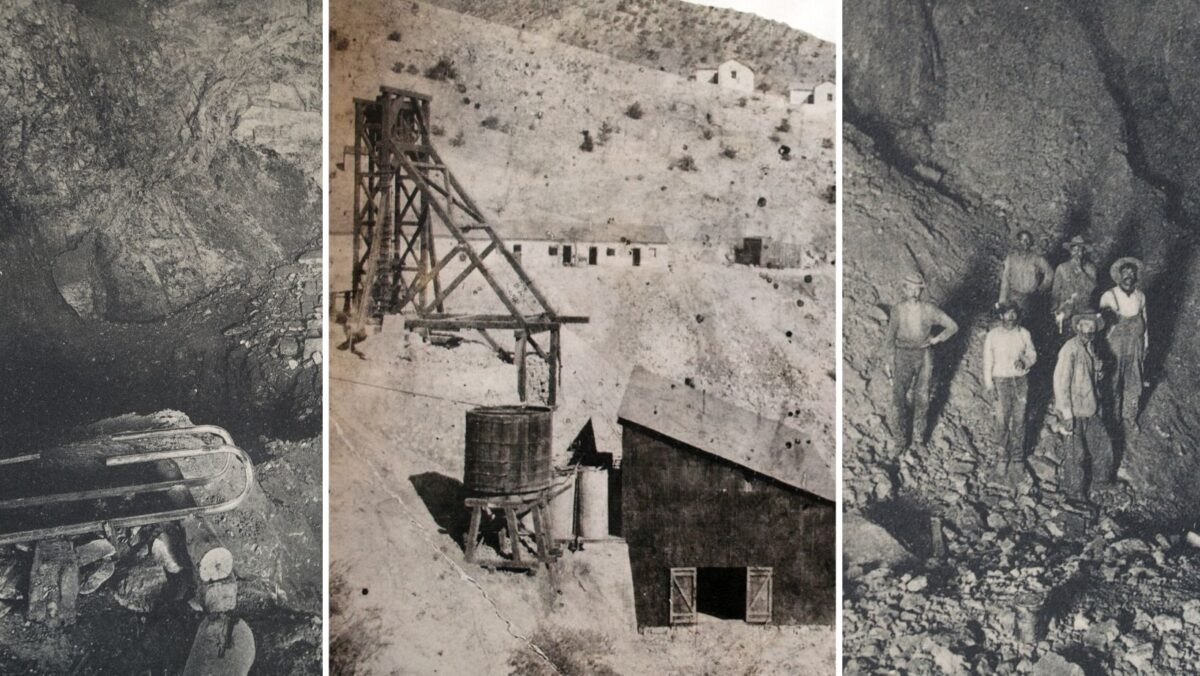
(1900) – The development of the great Pilares copper mine, Nacozari, in Sonora, Mexico, and the construction of big concentrating, smelting and converting plants have been accomplished under conditions which, considering the size of the undertaking, would have been prohibitive to less determined operators. The owner of the property is the Moctezuma Copper Company, otherwise Phelps, Dodge & Company of New York. It may be said the enterprise was never from the beginning an experiment. From the time, nearly three years ago, when Prof. James Douglas, president of the company, and Prof. L. D. Ricketts, geologist and metallurgist for the company, examined the mine, they knew the subsequent expense was justified. Their original plans, with unimportant modifications, have been worked out, and are practically complete.
The property comprehends the Pilares Mine, with more than three miles of underground work down to the sixth level, that blocks out and discloses nearly or quite 2,500,000 tons of sulphide ore; eight miles of mine and surface railway, an inclined plane, complete reduction plant, a modern town, and a railroad nearly 100 miles long that will bring it all within immediate reach of the transportation lines of the United States. Complete, the investment will represent considerably more than $3,000,000 American money.
The property is situated 98 miles south of Bisbee, Ariz., in the western spurs of the Sierra Madres. The town of Nacozari is in a valley through which flows a small stream, the Nacozari River, a tributary of the Yaqui. The reduction plant is south of this stream. The elevation of the town site is 4,000 ft. above sea level. Six miles eastward and more than 1,200 ft. higher, is Pilares mountain, in which lies the great body of ore.
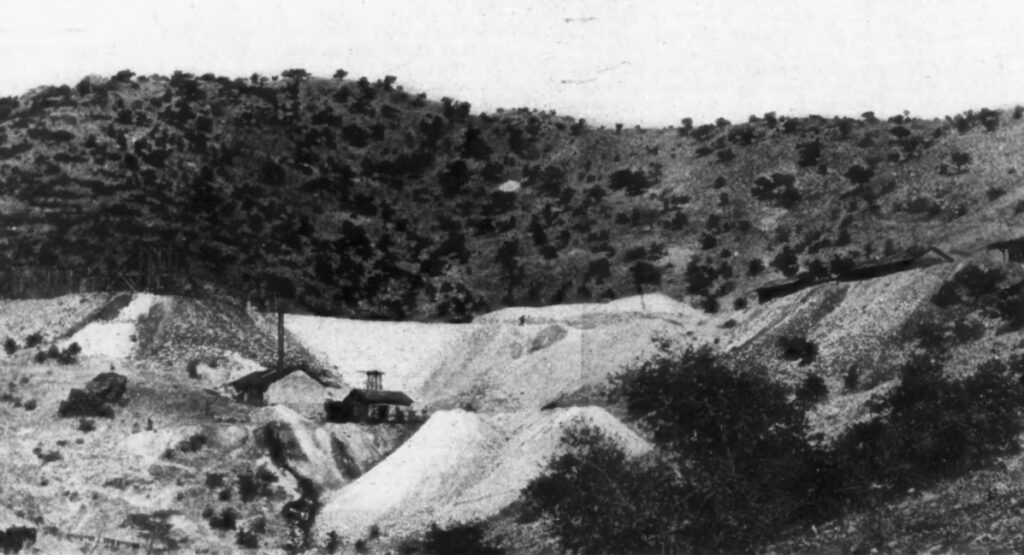
Topographically the mountain is rugged and steep, and great pillars of rock protrude above its crest, giving it the name of “Pilares”
The ore body lies in an eruptive belt of trachyte in birds-eye porphyry formation, capped with breccia, with perhaps trachyte as a binder. This belt may be traced in a southeasterly direction a distance of 3 miles to the Bella Union, another of the company’s mines that has been only slightly prospected. Three miles west granite comes to the surface of mountains that extend north and south. The ore is chalcopyrite and silicious rock, although the surface ore contains considerable black oxide of copper. The constituents of the average ore as analyzed by Daniel Huff, the mine surveyor, shows: Silica, 45.5; alumina, 24.82; iron, 8.5; copper, 8.0; sulphur, 12.25; lime, 0.68; magnesia, 0.30.
When work in progress is completed all the ore in and above the sixth level will be run to the mill by gravity. At present, however, the underground workings and the system of extracting ore, stoping, etc., are as follows: The perpendicular work consists of a main 3-compartment shaft, equipped with steel safety cages. Two o1 the cages are operated by a 25 H.P. double-cylinder vertical Union gasoline engine, with two-compartment type drum, that lifts 1% tons 165 ft. per minute, and at the same time lowers the other cage. The other cage is operated by a horizontal Otto engine and is at present used in sinking pelow the third level, the present depth. The other two are used to hoist ore from the second and third levels. Three winches also extend from the first to the fifth level. The first level is a tunnel 2,000 ft. through the mountain from southeast to northwest. A radiating drift 1,000 ft. long intersects this tunnel near each portal. The main shaft is on the surface at the southeast end and 500 ft. west of the tunnel, and ore hoisted from the second and third levels is trammed through the tunnel and deposited in bins at the opposite end. The ore body on the first level is 90 ft. wide. Stoping is now in progress.
The second level was begun as a tunnel, but now radiates from the main shaft. The drifts and crosscuts aggregate 2,000 ft. and the ledge is 87 ft. wide. The third level drifts 1,000 ft. in the ore body, with 6 crosscuts, the longest 105 ft., still in ore. The fourth level is in water, but 800 ft. of drift and 2 crosscuts 75 ft. each are all in ore, and were run before water necessitated a discontinuance of work. Like the fourth, the fifth level is in water. It has 500 ft. of drift and one crosscut of 75 ft., without reaching the limits of the ore body. The sixth level is a 7 by 9 ft. tunnel beginning at Porvenir, at the terminus of the railroad in Rosario Canyon. It will tap the main shaft 5,000 ft. from the portal. It is now in nearly 2,900 ft. in birds-eye porphyry and must strike the ledge before long. Two Ingersoll-Sergeant drills work night and day. When the tunnel is completed all ore from above will be lowered and all from below will be hoisted and pass out through this tunnel. Until it is completed the ore from the first three levels will be deposited in bins at the portal of the first level tunnel, as described previously. From the bins it will pass to steel ore cars that will be run to the incline and there lowered to the railroad. The incline is 1,900 ft. long, 33 per cent. grade, 3 ft. gauge. The cable attached to skips on each track weighs 3,000 lbs. The machinery that controls the cable at the head of the incline is massive and firmly anchored. The main pulley wheel weighs 7 tons and is controlled by two steel friction bands attached to powerful levers. At the base of the incline the cars are run off the skips onto the railroad.
On account of the excessive cost of timber, stoping will be prosecuted on the filling system. Waste will be run down from the surface through the winzes and thrown into place in courses of 6 ft. The tunnels and drifts are, however, timbered with 10 by 10 in. stuff. The sets are 4 ft. 10 in. from center. 6 ft. 6 in. high. Adjacent to these main ways ore chutes are to be constructed with loading vents at intervals of 50 ft., and ample manways will be provided.
The task of hauling hoisting machinery, air compressors and mine cars through a mountainous country to the additional high altitude of the mine was in itself a hard one; but how infinitely more difficult it was to haul thousands of tons of rails, ties, beams, engines, blowers, water jackets, converter vessels, crushers and hundreds of other items, the experienced reader will readily appreciate. At a rate of from $20 to $24 gold per ton from the railroad terminus at Naco, near Bisbee, the hauling charge for this tonnage has eaten a good sized hole into $75,000. But everything is of the utmost stability and the best that skill can produce.
The 3 ft. gauge railroad from the reduction plant at the town, 5% miles to the mine, is as carefully constructed as any trunk line road in the United States. For grades and curves it equals some of the Colorado mountain climbers. The longest tangent is 800 ft. snake-like, with several 40° curves, it climbs more than 600 ft. in its length, and has three trestles, one 400 ft. long and 81 ft. high; a 400 ft. tunnel through solid rock, and many deep fills. The curves are elevated to a 15-mile speed, and ascending from the mine they are compensated so that loaded cars going down require the same power as empty cars going up. The 40-lb. rails are all laid on tie plates and are aligned to a lead pencil point. During the period of construction 700 Mexicans have been employed at one time, with only J. W. D. Moodie, superintendent, his assistant, Mr. York, and one or two other skilled track men to direct such a motley army. The road is estimated to have cost $63,000 Mexican currency per mile. The ore cars are steel of 6 tons capacity. The ore bins are also steel, of 1,500 tons capacity. A steel trestle extends from the railroad over the bins at the concentrator, into which the ore is deposited from the cars, and from there it passes by gravity into the rock crushers of the concentrator.
Electricity is the power that drives the several departments of the reduction plant.
The power house is a steel structure 108 by 62 ft. The steel framework supports a 12-ton traveling crane with a span of 25 ft., available in any part of the building. The dynamos are operated by eight Crossley gas engines made in Manchester, Eng., rated at 110 H.P. at 200 revolutions per minute. Each engine with, flywheel weighs 40,000 lbs. They are the four-cycle, hit-and-miss type. The gas is produced by the Loomis water-gas system. Eight tanks contain water for the circulating system for cooling the cylinders. Each engine is belted direct to a 65-Kw. 260-volt shunt-wound direct-current General Electric generator with normal speed of 910 revolutions per minute. The reason shunt-wound instead of compound-wound machines were selected is to insure protection against any lapses of the engines. If any one of these should drop its speed below normal the affected dynamo for the time being would become a motor and would not, therefore, interfere with the action of other motors. The current from the eight generators is carried to a switchboard by overhead cables. The switchboard consists of eight generator panels, one main station panel and one feeder panel. The current is transmitted to the departments over four circuits of Standard conductor, each having an area of 500,000 circular mils. Two of the circuits are taken to two distributing boards in the concentrator, one for each mill, giving a total of 500 H.P. with an overload capacity of 25 per cent. Another is taken to the furnace and converter blower room and the fourth set of feeders is distributed about the plant for other machinery and lighting. Any dynamo may be cut off from the switchboard from three different points in the power house—at the switchboard (at quick-break switch), at either dynamo, and at either engine by a push button that operates as a solenoid on the circuit breaker. The lighting equipment at the beginning for mill and town consists of 400 C. P. 250-volt incandescent lamps and 10 arc lamps, constant potential. A telephone service will connect all departments.
Written for the Engineering and Mining Journal
New York, New York, June 9, 1900
Vol. LXIX, No. 23
About the author:
H. B. Layton was an American mining correspondent and technical writer active around the turn of the twentieth century. He contributed articles on mining operations in the U.S. Southwest and northern Mexico to leading industry publications. Little is known about his personal life, but his work was widely reprinted in regional mining newspapers.
© All Rights Reserved