
Mineral Wealth of Mexico Shown at Nacozari
7 de septiembre de 2025
(Unknown Author)
“Close to Nacozari, at Pilares, are some of the richest copper mines in the world”
(1919) – One of the best examples of the development that may be looked for throughout Mexico whenever universally cordial relations between Mexican and American capital are resumed, is shown at Nacozari, 75 miles south of the Douglas, the center of the famous Moctezuma copper district. Close to Nacozari, at Pilares, are some of the richest copper mines in the world, steadily producing the red metal and continually operated with harmony between the Americans who own them and the Mexicans, who make up the great proportion of the labor employed.
These mines, owned by the Moctezuma Copper Company, a branch of the Phelps-Dodge corporation, have been in operation by modern methods for a score of years but, as yet, the extent of the ore bodies yet to be tapped has never been determined.
Previous to having been taken over by the American mining interests, the Moctezuma mines had been worked off and on for hundreds of years, under the most primitive methods. At Nacozari the large deposits of low-grade ore were known for years, and the high-grade streaks had been mined with shallow holes run on the rich seams of gold, silver and copper.
The property jumped into prominence, however, only when it was determined that the low-grade ore could be properly treated and made to yield a profit with the installation of a large amount of equipment and the construction of a railroad. This work was immediately taken up. The best equipment obtainable was installed at Nacozari, road gangs were put to work and, after nine years of progress, the Moctezuma company had reached the stage where it could see its properties yielding a profit.
The Pilares de Nacozari mine, including the Esperanza, has so far proven the best of the company’s group. The ore of the Pilares has been skillfully opened. In the development work only the most modern lighting and ventilating equipment has been installed, and every effort made to bring the maximum of production with a minimum of safety. The mine is connected with the mill, six miles away, by a railroad which enters the mine on the seventh level of the Porvenir tunnel.
The concentrates from the Nacozari properties are melted at the Copper Queen smelter at Douglas. Concentrates make up the greater part of the shipments from Nacozari, but some of the ore is sent for direct smelting.
The Pilares main ore body is in the shape of a pear, being at its narrowest about fifty feet wide and at the broadest about 1,000 feet. It has apparently two skins, each of solid ore, and one thicker than the other. In the center are two “seeds,” one averaging 75 x 175 feet, the other more than half as large—and these are solid ore.
The ore is found around the entire pear, the narrowest point being 15 feet and the widest 200 feet.
There are two main shafts at the Pilares, the Esperanza and the Pilares. A third five-compartment shaft is being sunk to connect with the other workings and is now down 1,600 feet.
Two new hoisting engines, of large capacity, were recently installed at the mine and, within the next few months, two 40,000 cubic-foot Diesel air compressors will be ready for action. At the powerhouse, at Nacozari, two additional, 2,000 horsepower engines have been erected during the last year and other big power products are contemplated. Preparations are being made to remodel the mill at Nacozari to treat 3,000 tons of ore a day. The present capacity is 2,400.
Looking to the interests of the employees, the workmen’s rooming house and hotel have been renovated and remodeled, and plans are being made to improve the plaza with cement walks, a dancing floor and other features. A new plaza has been constructed at Pilares for the miners. A new dormitory has also been constructed at the mine for members of the operations staff, containing a billiard parlor, dining and reading rooms, etc.
Production at the mine was curtailed during the latter part of 1918 and the first six months of 1919 by the wreck of one of the 1,000 kilowatt turbines in the powerhouse, but this was replaced by two 1,000 horsepower Diesels and further delay prevented. The boiler plant was also changed from coal to oil burning during the last year.
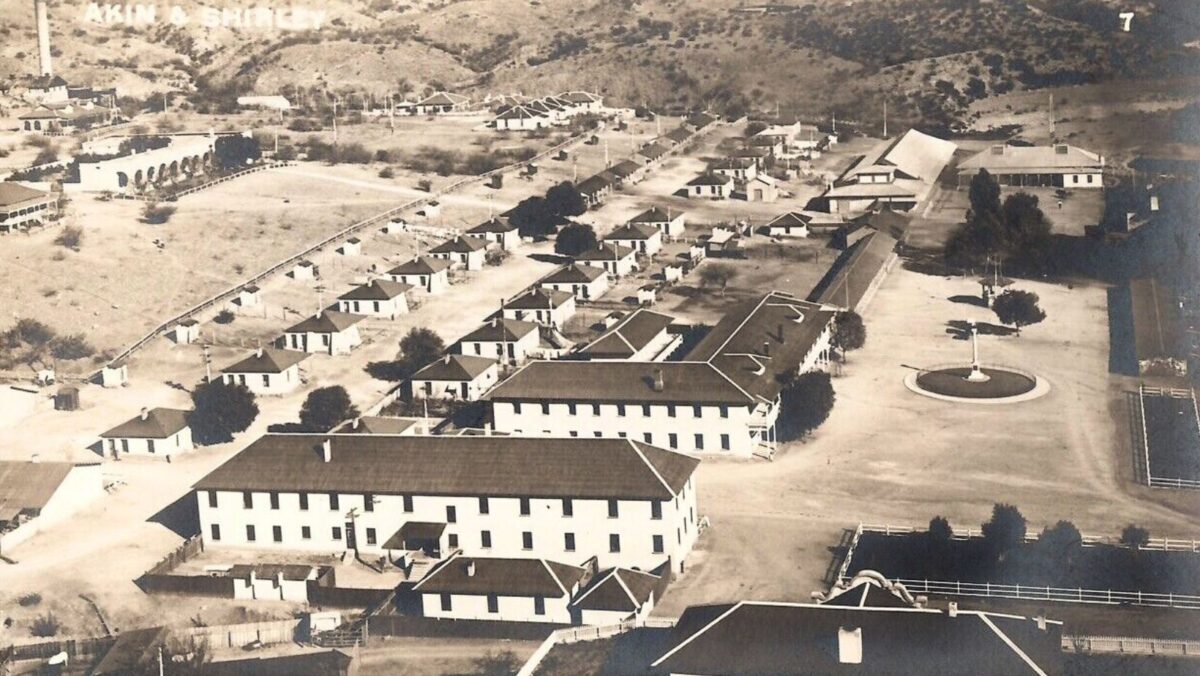
Since its acquirement of Moctezuma properties, the Phelps-Dodge policy has been one of upbuilding and steady preparation for the bigger things of which the property has been deemed capable from the very beginning. In the first place there was the necessity for railroad production; the size of the property and the low-grade character of the greater part of its immense mineral deposits made immediate consideration of transportation facilities and economic necessity. The railroad was surveyed from Douglas and built. Mill construction and other steps followed, including the provision of needed buildings and houses, which were erected at the town of Nacozari, the headquarters of the company, and where facilities were provided and have been maintained, which make for employees a very highly home residence place, the attractiveness of which is enhanced by the magnificent mountain scenic surroundings. There have been made available at Nacozari a library, club, gymnasium, hotels and other public advantages. Also the company conducts its own store that is second to none in the Mexican state and carries a wide range of all department house goods.
J. S. Williams, Jr., of Douglas, one of the pioneer mining men of the southwest, is active general manager of the Moctezuma Copper Company and Nacozari Railroad, with offices in Douglas. The officials of the company at Nacozari and Pilares are: H. T. Hamilton, manager; W. Rogers Wade, mine superintendent, F. A. Ayer, assistant mine superintendent; M. A. Mitchell, superintendent, and W. E. Nashburn, superintendent of machinery.
Published on Douglas Daily International
Douglas, Arizona, October 31, 1919
Vol. XIX, No. 119
© All Rights Reserved