
Lewis Douglas Visits the Hero of Nacozari
22 de febrero de 2026
By Enguerrando Tapia
“Jesús García will live forever in my heart… a just man with a personality of his own.”
(1984) – In 1904 he became an engineer for the rail road between Nacozari and Pilares. On the 7th of November of the year 1907, he received orders to bring the locomotive into the yard and couple several gondolas. Two of them were loaded with dynamite for the Moctezuma Copper Company.
When he reached the first switch, Phelps, an American, noticed that some of the cases of powder in one of the gondolas were on fire. The train was stopped, and an immediate search for water or dirt was begun. They found none. The fire was spreading. All the brakemen fled. Everyone was running.
Jesús García stopped one of them, and they released the three last cars on the train. He then climbed aboard his locomotive and began the steep climb with his deadly cargo. There were at least 1,500 yards more, before he could reach the first switch and the escape into open terrain. He was attempting to reach this, point when there was a terrific explosion. On this same spot, a marble memorial stone was placed…
– – –
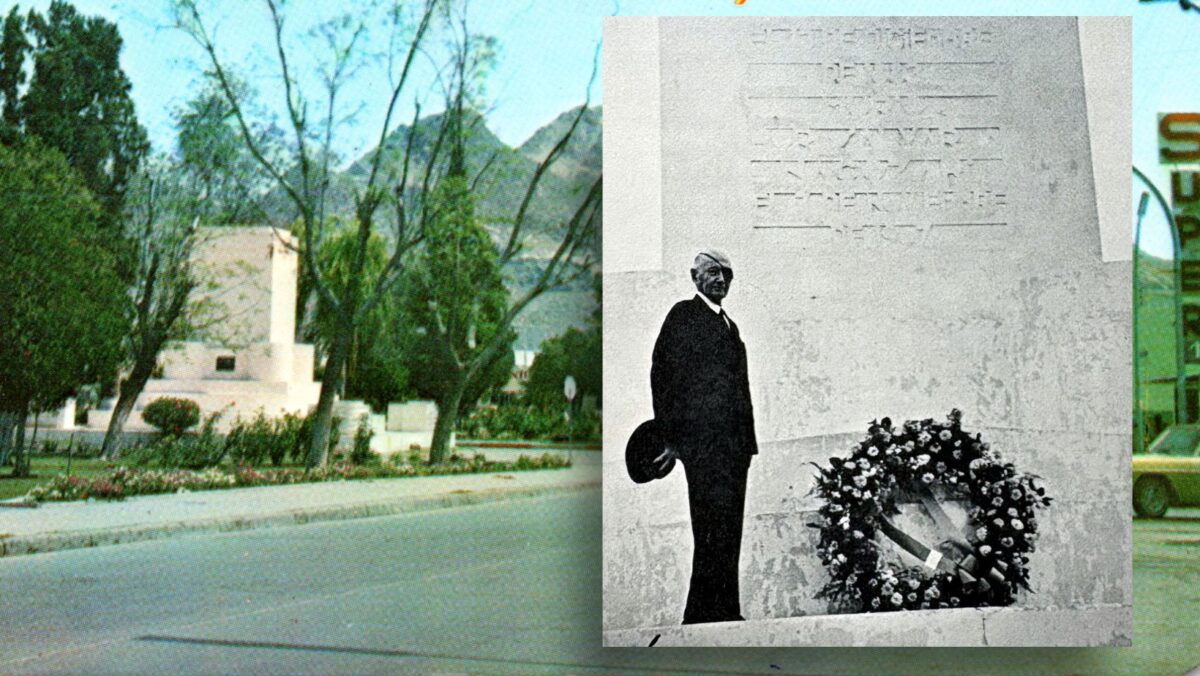
A few pedestrians crossing Serdan and Jesús García avenues, around six o’clock in the evening, curiously noticed the erect and slim figure of an elderly and elegant man who, unhesitatingly, climbed the high steps of the monument to the Hero of Nacozari, erected on the entrance of the main avenue of the City Park Francisco I. Madero. Wearing brown trousers and a matching sport jacket, Lewis Douglas, President of the Board of Directors of the Southern Arizona Bank and Trust Co., one of the most important banking institutions of the southwestern part of the United States, former ambassador to the Court of St. James in England, an intellectual, a lecturer, and a genius in the world of finance had come to pay homage to Jesús García.
I approached the elderly gentle man, whose face bears a distinctive black patch over the left eye, which he lost a few years back.
“I have come to bring my friend a bouquet of roses,” Lewis Douglas told me, “because back in Nacozari Jesús García was my friend.”
“Did you know him?” I asked.
“Yes, back in 1905, 1906 and 1907 when I was very young, I was a friend of Jesús’ in Nacozari, where my father headed the Moctezuma Copper Company mines.
“He was quite a man! Jovial, hard working, friendIy with everyone… and especially with the children.” And the light of one who is caressing a dear memory gleams in Mr. Douglas’ only eye.
“Every Sunday, we used to ride together on my horses, and then I would ride with him on the loco motive when he conducted.”
“When Jesús García died, were you in Nacozari?”
“Yes. It was on November 7, 1907. It was a day of sorrow for Nacozari when the train loaded with dynamite· exploded; but what a glorious day for humanity, to gain Jesús García as a hero.
“You know the story,” remarked the old gentleman with the thinning gray hair. “I lived it and I will always remember it. Jesús García will live forever in my heart… a just man with a personality of his own. What great courage he had! What integrity! He did not hesitate for an instant to choose between saving his life and that of the entire town.”
Night falls in Hermosillo.
Lewis Douglas and Sherman Montgomery, an officer of the Southern Arizona Bank who accom panies him, remain standing before the monument.
I remember those beautiful words read by Mr. Douglas many years ago when as an ambassador in London he stated that Jesus Garcia was “the most admirable man I have ever known.”
I also remember that on many occasions I have read that whenever he has the opportunity, Mr. Douglas always proclaims his admiration for the Hero of Nacozari.
Also, I remember an anecdote that has been passed on down among the miners of Nacozari and Cananea, dating back to the beginning of the century, when Mr. James S. Douglas was director of the Moctezuma Copper Company.
It is said that when Lewis Douglas went to the barber shop as a young man, he was a generous tipper, contrary to his father, James S. Douglas, who gave a more con servative tip.
One day, when the confused barber asked Mr. James S. Douglas why there was such a difference, he replied, “Lewis has a father with resources that enable him to tip generousIy… I do not.”
I become persistent in my questioning before this impromptu interview comes to an end.
“How old were you when Jesús García died?”
Mr. Douglas does not seem to understand the question; he has told me that he Is forgetting his Spanish. I repeat, “How old are you, Mr. Douglas?” He answers me with a smile. “I am years older than I would like to tell you… they are enough.”
We said goodbye. The ex ambassador of the United States to Great Britain; the banker respected by the titans of finance of the richest country in the world; the diplomat—a man who having received the honors of a lifetime prodigious in achievements, a man who having known statesmen and kings, princes and magnates, considers having been a friend of Jesús García the greatest honor in his life.
And he stops to chat in simple and affectionate phrases with a group of youngsters who are playing near the monument of the hero he once knew.
Published on Jerome Ghost Post
Jerome, Arizona, April, 1984
Vol. 2, No. 4
© All Rights Reserved