
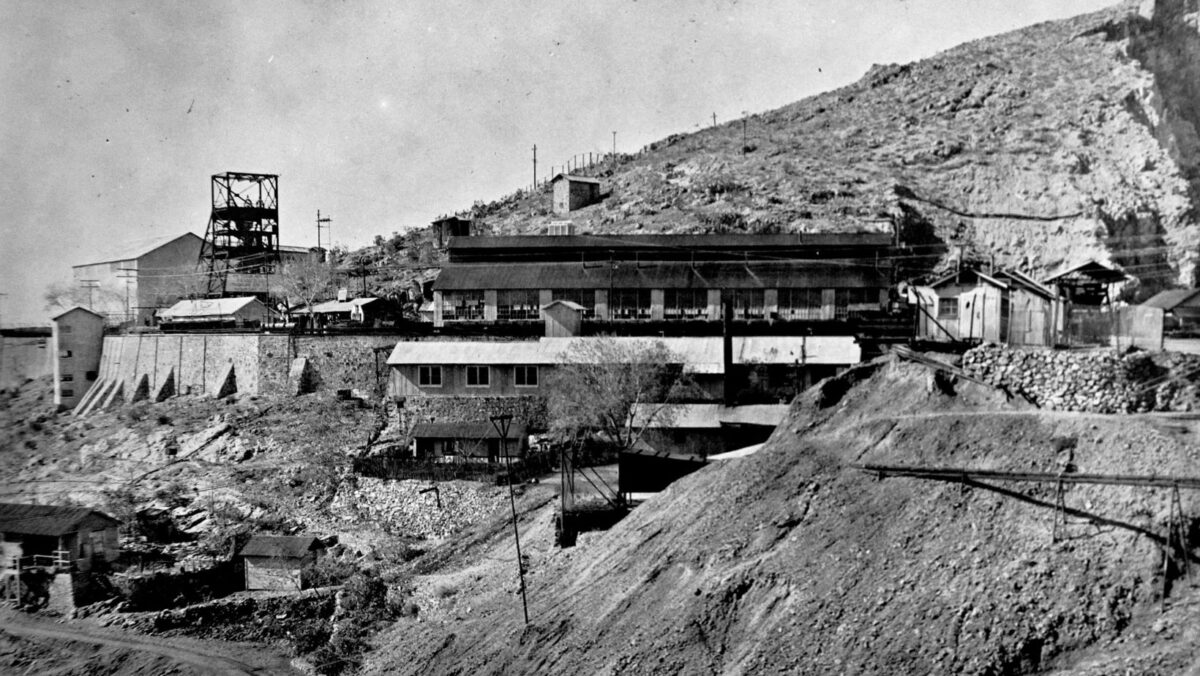
Moctezuma Copper Company, First Important Sonora Producer (1917)
8 de septiembre de 2025
(Unknown Author)
“It is considered one of the great copper properties of the world.”
(1917) – The Moctezuma Copper Company, operating in the Moctezuma mining district of Sonora, 75 miles below Douglas, equal to the production with present equipment of around 40,000,000 pounds of copper per year, is the outgrowth of the entry of Phelps-Dodge to activities in Sonora in 1896, when their engineers advised the taking over of the lands now held under the Moctezuma Copper Company S. A., the Mexican organization, and comprising approximately 2,000 acres. In addition to these mineral lands, the company owns ranch lands totaling 35,000 acres, valuably timbered.
The Moctezuma is now included in the Phelps-Dodge & Company holdings. It is considered one of the great copper properties of the world. Since organized, the Moctezuma Copper Company has paid dividends in excess of its capitalization of $3,000,000 by more than $2,000,000. It is in excellent way to continue good returns for many years. Diamond drill holes and extensive development by tunnels, drift and crosscuts have shown more than fifteen years’ ore in sight. This is considered only a beginning by those familiar with the great mines and the possibilities of their attending resources.
There have been 2,500 men on the Moctezuma Copper Company payrolls the present year. The Phelps-Dodge policy of fair attention to development as well as production prevails in the Moctezuma mines, as in their other properties. This year the Moctezuma mines will receive around 24,000 feet of development work, or between four and six miles. The great part of this will open into new ore bodies and into new ore.
Employees of the Moctezuma Copper company are mainly Mexicans, and number some of the most skilled drillers in the country. J. S. Williams, Jr., is superintendent. He is a son of ex-Mayor Williams of Bisbee, and comes from a mining family, the reputation of which has been given additional luster by the excellence of his work with the Moctezuma. The Moctezuma employes have been diverted from their employment by the war troubles in lesser degree than those of any other mining company in Mexico.
Reputation for Bigger Things
Since its acquirement of Moctezuma properties, the Phelps-Dodge policy has been one of upbuilding and steady preparation for the bigger things of which the property has been deemed capable from the beginning. In the first place there was the necessity for railroad construction; the size of the property and the low-grade character of the greater part of its immense mineral deposits made immediate consideration of transportation facilities an economic necessity. The railroad was surveyed from Douglas and built. Mill construction and other steps followed, including the provision of needed buildings and houses, which were erected at the town of Nacozari, the headquarters of the company, and where facilities were provided and have been maintained, which make for employees a very highly desirable home residence place, the attractiveness of which is enhanced by the magnificent mountain scenic surroundings.
There have been made available at Nacozari, library, club and gymnasium, hotel and other public advantages. Also, the company conducts a store that is second to none in the state, and carries a wide range of all department house goods. The moral side of things has been looked after, and the customary mining camp red light district and freedom of saloon privileges is lacking in this camp.
Mined for Hundreds of Years
Previous to their acquirement by Phelps-Dodge through the organization of the Moctezuma Copper Company, the rich ores of the Nacozari locality had been mined off and on for hundreds of years, under primitive methods. Eighty miles down the Moctezuma River is the ancient city of Moctezuma, with its cathedral of more than 300 years of age. A normal population of about 4,000 belongs to Moctezuma. Established during the days of the conquest, its surrounding country came under more or less ramping from the beginning.
At Nacozari, the large deposits of low-grade were known for years, and the high-grade streaks had been mined with shallow holes run in on the rich seems of gold, silver, and copper. The property became valuable, however, as a big asset, only upon its being determined that low-grade ores could be treated with profit upon provision of adequate machinery equipment and railroad transportation facilities. It was these things that Phelps-Dodge determined in advance of acquirement of the property, and subsequently provided. It was not until nine years after organizing the Moctezuma company, and taking over the property, that the company had advanced to its extensive preparatory work to a point where it was able to earn profits in excess of necessary outlays. Since that time, with exception of 1908, when further large expenditures were made in enlargement and improvement of facilities, dividends have been earned.
There has also been a large cash surplus fund created, its availability at the present time giving ample assurance of comfortable future circumstances for the company, without inroads upon dividends to meet new equipment or mining expenses that may be deemed advantageous. In other words, it is a thoroughly good, sound and satisfactory business footing that this big Sonora enterprise has attained, at the expense of much outlay of money in its early days and a great deal of time, patience and high mining.
Other Valuable Properties
Although the company owns other valuable producing properties, notable among these being the Bella Union, Fortuna, Churunibabi, and San Francisco, the Pilares de Nacozari mine, including the Esperanza, has towered so far above the others in readily available and seemingly ending resources that it has dwarfed everything else. The Pilares is unquestionably a great mine. By many authorities it is compared with Rio Tinto, and it is considered to have one of the largest ore bodies in the world.
Its ore has been very skillfully opened. The mine is provided at this time with a system of electric lighting, ventilation, etc., that makes its operation possible at the minimum of cost, and at the same time provides the maximum of safety for workmen as well as the maximum in generally good conditions attainable underground. The mine is connected with the mill, six miles distant at Nacozari, by railroad. This latter enters the mine workings through the Porvenir tunnel, of length of a mile on the seventh level. The tenth level tunnel carries the main water output of the mine, which is disposed of readily.
To Copper Queen Smelter
Nacozari concentrates are smelted by the Copper Queen smelter at Douglas. Shipments from Nacozari are mainly concentrates, although there is also direct smelting ore steadily shipped from the property. The concentrates are treated cheaply at Douglas. The mine costs at Nacozari are low, because of the advantages accorded by the mine in its deposition of ores, their accessibility in great part by tunnel and stope, the property having some of the biggest stopes in the world, the near availability on their own property of a good part of the timber required, which is not extensive in the firm-standing ground prevailing to large extent in the property, the extensiveness of modern labor saving equipment employed. These points tend to make the Moctezuma a very enviable mine from the cost sheet standpoint.
The Pilares mine main ore body is in the shape of a pear, being at its narrowest about fifty feet wide and at the broadest about 1,000 feet. It has apparently two skins, each of solid ore, and one thicker than the other. In the center are two “seeds,” one averaging 75 x 175 feet, the other more than half as large—and these “seeds” are solid ore. A part of the outer skin on the north is what the miners call “caliche,” or a dike of very soft andesite (that is, the ore for some distance is connected with this dike, which generally forms the hanging wall), through which the only water in the mine percolates from the surface. This caliche is treacherous, slippery, and the “slick-ensides” show much of it in slips. The ore on the south side of the pear is next to a well-defined wall of hard andesite, dipping slightly. Between the skin and the seed of the pear the material is barren. The larger seeds is the Guadalupe stope and the smaller the San Juan.
The ore is found around the entire pear (or as some call it, the horseshoe), the narrowest point being 15 feet and the widest 200 feet. The outer and larger ore body around the inner and smaller averaging 40 feet, each solid ore running all the way up from two per cent.
Eleven levels are opened and developed and being worked now. On the Pilares side ore is extracted from the side of the mountain by “tapping” it. Two methods of stopping are employed. In one they break the ore continuously for 100 or 200 feet at a stretch, the miners reaching the roof by standing on the broken ore, and drawing off the surplus as it is broken down. When the limit of the wall-strain is reached, all the ore is drawn off and the space is filled with waste from the surface. In the other method they take shortcuts, ten to fifteen feet high, draw all the ore and fill to within a few feet of the roof, then making another cut and proceeding as before.
Nothing But Ore
After one gets underground in this great mine, he almost forgets that the country is andesite with a volcanic overflow of rhyolite, because you see practically nothing but ore. A large part of this rhyolite is brecciated, and practically all the ore is found in these two bodies, but the andesite body was the original source of the ore. A large amount of high-grade ore is found throughout the workings, and this is shipped direct to smelter, while the low-grade ores are taken to the concentrator at Nacozari.
The traction tunnel is on the seventh level and a mile and a quarter in length, connecting it with the narrow-gauge steam railway on the outside. In the tunnel an electric motor engine is used. Various sidings are laid in different parts of the tunnel, where ore bins are located, and the ore bins discharge directly into the cars without the use of any manual labor whatever. These bins are connected with ore chutes from every level above the seventh, and filled from the upper levels, the ore being taken from the stops in small cars and dumped into these chutes. This eliminates the use of the shaft for ore lifting purposes and decreases the mining costs greatly. After the ore is loaded in the small cars at the stopes, it is handled automatically. The two shafts are known as Esperanza or “Y” shaft and the Pilares shaft.
The “Y” shaft is about half the distance, and brings the ore up from the levels below the seventh, and the Pilares shaft is at the far end of the traction tunnel. In the floor of the traction tunnel is cut a seepage ditch through which all the water in the mine is carried to the outside. The waste is carried in the mine and used for filling the stopes.
In the vicinity of the Moctezuma Copper Company holdings at Nacozari, and on down the river, there are a number of other properties held by different interests. Among these is the Nacozari Consolidated Copper Company, which has made considerable headway with development work and is considered in a favorable way to make a valuable property. There are numerous other promising holdings, and upon the return of normal conditions to Sonora there is every reason for belief that the Nacozari-Moctezuma section will become a very busy and prosperous one in a mining way.
Survey by Southern Pacific
There have been made a survey for the Southern Pacific line from Guaymas up to the Yaqui River to connection with the railroad at Nacozari, and a portion of this grade was built before the development of war conditions, which stopped all work. When this road is built, as it doubtless will be upon the restoration of peace and stable conditions, a great area of splendidly mineralized country will be numerous. Besides the entry that will be given to Douglas and the smelting facilities in the city, which will be tremendous advantage both to Douglas and the interior country, there will be an outlet afforded to Guaymas, which upon the completion of the Panama Canal, will enable further great advantages, and of which Douglas, as well as the Sonora country, may find use to great purpose.
The property of the Moctezuma Copper Company is managed by J. S. Williams, Jr., who has acted in the same capacity for number of years. He is also at the head of the Nacozari Railroad Company, the line which runs from Douglas 75 miles south to Nacozari. Mr. Williams’ home is in this city.
Published on Douglas Daily International
Douglas, Arizona, December 17, 1917
Vol. XV, No. 235
© All Rights Reserved